Why the Same Size Fits Differently in Every Store When You're Midsize
Quick Answer: Sizes vary between brands because each drafts from its own fit model and grading rules, and midsize bodies sit exactly where grading distortion is worst — between the straight-size and plus-size blocks, where brands change methodology mid-range. Shop by measurements and garment flat measurements rather than size labels, and identify which grading style suits your proportions.
You bring three sizes into the fitting room now. Everyone does.
The label has become close to meaningless, and it is most meaningless in the range from about size 10 to 18 — which is where a large share of the population actually lives.
This is not vanity sizing being annoying. It is a specific technical problem in how clothing is drafted, and once you understand the mechanism you can predict which brands will work for you before you ever try anything on.

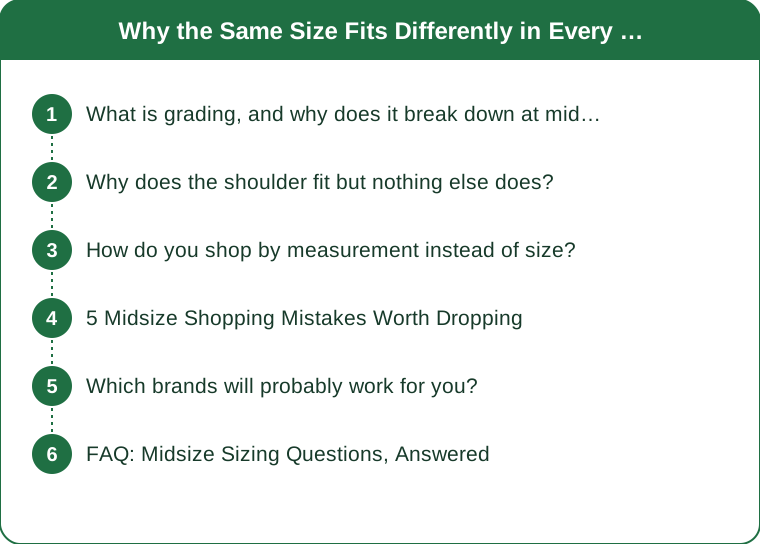
What is grading, and why does it break down at midsize?
Grading is how a brand scales one pattern into a full size run.
A brand fits a garment perfectly on one fit model — usually a size 8 or 10 — then applies mathematical rules to generate every other size: add so much at the bust, so much at the waist, so much at the hip, per size step.
The problem is that bodies do not scale linearly, and grading rules assume they do. As real bodies get larger, they change proportion, not just dimension. Waist-to-hip ratios shift, torso length changes, bust shape changes, and the shoulder does not widen at anywhere near the rate the chest does.
Midsize is exactly where the accumulated error becomes visible. You are typically four to six size steps from the fit model — far enough for compounding distortion, not far enough to be redrafted.
Plus-size lines are often drafted from a separate, larger fit model, which means the range from roughly 14 to 18 is the seam between two systems. Some brands stretch the straight-size block up. Some extend the plus block down. They produce wildly different garments at the same stated size.
Why does the shoulder fit but nothing else does?
Because shoulder width grades far more slowly than circumference measurements, and that is anatomically correct.
Shoulder breadth is skeletal and varies relatively little across a size range. Bust, waist, and hip are soft tissue and vary enormously. Good grading reflects that; mediocre grading widens the shoulder proportionally with everything else, producing tops that are correct through the body and too wide at the shoulder.
The reverse also happens: a brand that grades shoulders too conservatively produces tops that fit through the body and pull across the upper back.
Two things to check:
- Where the shoulder seam lands. It should sit at the edge of your shoulder bone. Beyond it means the garment is drafted wider than your frame, and no other adjustment corrects that.
- Armhole depth. This is the most commonly under-graded measurement in the entire industry. A deep enough armhole is more responsible for a top feeling comfortable than the bust measurement, and it is why sizing up so often fixes the wrong thing.
If you consistently size up for armhole comfort and then swim in the shoulders, you are dealing with a grading mismatch, not a body problem.
How do you shop by measurement instead of size?
Get the four numbers, then use garment flat measurements rather than body size charts.
Your numbers: bust at fullest, natural waist at narrowest, hip at fullest, and shoulder point to shoulder point across the back. Record them. Re-measure yearly.
Then the crucial step most people skip: look for the brand’s garment measurements, not their body size chart. A body chart says “size 14 fits a 40 inch bust.” A garment chart says “this top measures 44 inches around the chest.” The second tells you about ease — how much room is built in — which is what actually determines whether something fits.
Practical rules of thumb for ease:
- Fitted knit tops: 0 to 2 inches over your bust measurement.
- Relaxed woven tops: 4 to 6 inches.
- Structured jackets: 4 to 5 inches, and check the shoulder separately.
- Non-stretch bottoms: 1 to 2 inches over your hip.
Measure a garment you already own and love, then compare those numbers to anything you are considering. This is the single most reliable shopping technique available and it works across every brand, because it compares garments to garments rather than trusting labels.

5 Midsize Shopping Mistakes Worth Dropping
-
Buying your usual size in a new brand without checking. There is no usual size. Two brands can differ by three inches at the same stated size, which is larger than a size step.
-
Sizing up for one tight spot. If the bust pulls, sizing up gives you a bigger bust and a bigger everything else. Better: find brands whose grading matches your shape, or size for the shoulder and alter the body.
-
Ignoring fabric stretch percentage. A 4-inch difference in garment measurement is irrelevant in a fabric with 40 percent stretch and decisive in a woven with none. Read fiber content before comparing measurements.
-
Shopping the straight-size line when the extended line fits better. Many brands draft their extended range from a better-matched fit model. If you sit at the boundary, try the extended version of the same style — it is often a genuinely different and better garment.
-
Assuming a return means you were wrong. Returns are how you build the brand map. Two or three returns that teach you a brand grades wide at the shoulder is a good use of a season.
Number three is the one that costs people the most money, because it makes the measurement approach look unreliable when it is actually just being applied to incomparable fabrics.
Which brands will probably work for you?
You can predict this once you know your own proportional signature.
If your waist-to-hip difference is large, brands that grade with a defined waist and generous hip will fit you. These tend to be brands with contoured side seams and back darts. Straight-cut, boxy brands will gap at your waist consistently.
If your bust is proportionally larger, look for brands offering cup-size variation or princess seaming. Grading alone rarely solves bust proportion, and no amount of sizing up does.
If you are longer through the torso, check garment length measurements before anything else — length is the least consistently graded dimension in the industry.
Then build an actual list. Two columns in your phone: brands whose grading matches you, and brands that consistently do not. After a season this list saves more time and money than any styling advice.
The reframe worth internalizing: inconsistent sizing is a manufacturing artifact, not information about your body. The number on the tag describes a pattern-making decision made by a stranger. Your measurements describe you, and they are the only stable thing in the entire system.
FAQ: Midsize Sizing Questions, Answered
Why do sizes seem to keep changing over time?
Brands periodically re-fit their blocks and update fit models, and vanity sizing drift means the same numeric label has expanded over decades. A size 12 from 1995 and a size 12 today are meaningfully different garments.
Is it worth buying multiple sizes and returning?
Financially and environmentally it is not ideal, but practically it is often the only way to map a new brand. Do it deliberately for brands you expect to buy from repeatedly, and use the results to build your list rather than treating each trip as a one-off.
Should I get things tailored instead?
For structured pieces, yes — taking in a waist or shortening a sleeve is inexpensive and transformative. For knits and activewear, tailoring is harder and often not worth it. Prioritize alterations on woven pieces you will keep for years.
TL;DR:
- Sizes differ because each brand grades from its own fit model, and midsize sits where grading error peaks.
- The 14–18 range is a seam between two drafting systems, which is why it is the most inconsistent.
- Shop from garment flat measurements, not body size charts — that is what tells you about ease.
- Measure a garment you already love and compare numbers to anything new.
- Build a personal list of brands whose grading matches your proportions. It compounds.
Once you stop treating the tag as information, the whole category becomes manageable. You are not hard to fit — you are being sized by a system that quietly changes its own rules halfway through the range.
Keep Reading
This article is for general informational and styling purposes only. Fit, sizing, and product availability may vary.