Why Sweaters Read Bulky on Midsize Bodies and What Actually Changes It
Quick Answer: Bulk comes from gauge, shoulder seam position, and hem placement - not from size. Choose a fine or mid gauge over a chunky one, check that the shoulder seam sits at the edge of your shoulder rather than down your arm, and look for a hem that ends either above the widest part of your hip or several inches below it. Sizing up on a chunky knit with dropped shoulders adds volume exactly where it already had too much.
You tried the sweater in three sizes and all three looked wrong in a slightly different way.
That is what a gauge and seam problem looks like from inside a fitting room, and no fourth size was going to fix it.

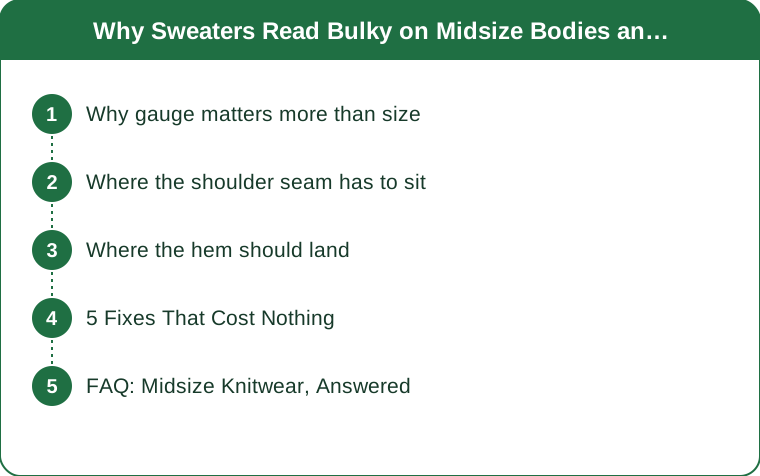
Why gauge matters more than size
Gauge is the thickness of the yarn and the density of the stitch, and it determines how much physical volume the garment adds to your outline. A chunky knit can add an inch or more of thickness around your entire torso, which no amount of size adjustment removes.
Fine gauge follows the body; chunky gauge builds its own shape. This is why the same design in merino at a fine gauge reads sleek and in a chunky wool-blend reads like furniture, at identical measurements.
Midsize bodies frequently sit at the point where that added inch tips the silhouette, which is why the effect feels more pronounced here than at either end of the size range.
Mid gauge is the practical sweet spot - substantial enough to feel like a real sweater, fine enough not to add visible volume. Most well-made merino and cashmere sits here.
If you want a chunky knit anyway, and they are worth wanting, the way to make it work is to balance it: chunky on top demands something slim and defined below, and a chunky knit over wide-leg trousers is what most people are actually reacting to when they say the sweater looked bulky.
Where the shoulder seam has to sit
On the outer edge of your shoulder, where the arm begins. This is the single most reliable predictor of whether knitwear reads intentional or oversized-by-accident, and it is easier to check than any measurement.
A seam that falls down your upper arm creates a horizontal line at your widest visual point and drops the whole garment, which reads as bulk regardless of how the rest fits.
Dropped shoulders are a deliberate design in many sweaters, and they can work - but they work by being clearly and generously dropped, not by being a size too large. An accidental drop of one inch looks like poor fit; a designed drop of four inches looks like a style.
Raglan sleeves sidestep the issue by having no shoulder seam at all, which is why they often fit a wider range of bodies without alteration.
Check the seam before you check anything else in the mirror. If it is wrong, no other adjustment rescues the garment, and you have saved yourself trying two more sizes.

Where the hem should land
Avoid the widest point of your hip. A hem that ends exactly there draws a horizontal line at the widest part of your silhouette, which is the most common single cause of a sweater looking wider than the body inside it.
Above the hip works - at the high hip or just below the waist - because it defines the narrowest part and lets the rest of the outfit continue the line.
Well below the hip works too, at mid-thigh or longer, because the eye reads a continuous vertical rather than a stopping point. Longline knits are genuinely flattering for this reason and are underused.
The problematic zone is a two- to three-inch band around the fullest part of the hip, which is exactly where a great many standard sweaters end.
A front tuck solves it in ten seconds if the sweater is otherwise right. Tucking just the front section at the center raises the visual hemline to your natural waist while keeping the back covered.
And check the hem’s own construction. A tight ribbed hem cinches and creates a balloon above it; a loose or straight hem falls cleanly. On a midsize body the tight rib is usually the worse choice.
5 Fixes That Cost Nothing
One: the front tuck. Tuck two or three inches of the front hem into your waistband and leave the rest. It relocates the horizontal line to the narrowest point and works on almost any knit.
Two: push the sleeves up. Showing the wrist and forearm breaks up the fabric mass and adds a visible line of skin that reads as structure. It is the fastest available change and one of the most effective.
Three: add a vertical. An open long cardigan, a scarf hanging down, or a necklace that sits low creates a vertical line through the middle of a horizontal garment.
Four: slim what is below. A chunky knit with straight or wide trousers reads bulky; the same knit with a slim trouser or a fitted skirt reads deliberate. The sweater was rarely the problem on its own.
Five: check the shoulder before the size. If the seam is down your arm, put it back and try a different cut rather than a different size, because the size was never what was wrong.
FAQ: Midsize Knitwear, Answered
Should I size up in sweaters for comfort?
Usually not. Sizing up in a knit adds width and length everywhere, including the shoulder, and knits already have give. Size for the shoulder and let the body of the garment do its job.
Are chunky knits off-limits?
Not at all - they need balancing rather than avoiding. Slim below, sleeves pushed up, and a defined waist if the shape allows.
What is the most flattering sweater length?
Either above the widest hip point or several inches below it. The band right at the fullest point is the one to avoid.
Does fiber matter as much as gauge?
Gauge matters more for silhouette, fiber matters more for drape and longevity. Merino and cashmere drape closer to the body than acrylic at the same gauge.
Can a sweater be altered?
Rarely worth it. Knits are difficult to alter well, and shoulders in particular are a major job. Choose the right cut instead.
What about layering under a coat?
This is where fine gauge earns its cost. A chunky knit under a fitted coat creates bulk at the arms and chest, which is why fine-gauge layers work better for the whole cool-weather season.
TL;DR:
- Bulk comes from gauge, shoulder seam placement, and hem position - not from your size.
- Check that the shoulder seam sits at the edge of your shoulder before you check anything else.
- Avoid hems that land at the widest point of your hip; above or well below both work.
- A front tuck and pushed-up sleeves fix most of what is left, in seconds and for free.
- Chunky knits need slim silhouettes below them; fine gauge layers best under coats.
If three sizes all looked wrong in different ways, the cut was wrong. Change the garment, not the number.
Keep Reading
This article is for general informational and styling purposes only. Fit, sizing, and product availability may vary.
