Why Jeans Gap at Your Back Waist When Everything Else Fits
Quick Answer: Back waist gap happens when your hip-to-waist difference is larger than the ratio the jeans were graded for. The jeans fit your hips, so the waist — sized proportionally to those hips — ends up too large. Sizing down does not help because it makes the hips too tight before it fixes the waist. The real fixes are a contoured waistband, a higher rise, a tailored waist nip (about $20), or stretch fabric with strong recovery.
You can fit your fist in the back of your jeans. The hips and thighs are perfect.
Nothing is wrong with your body or your size — the pattern assumed a ratio you do not have.

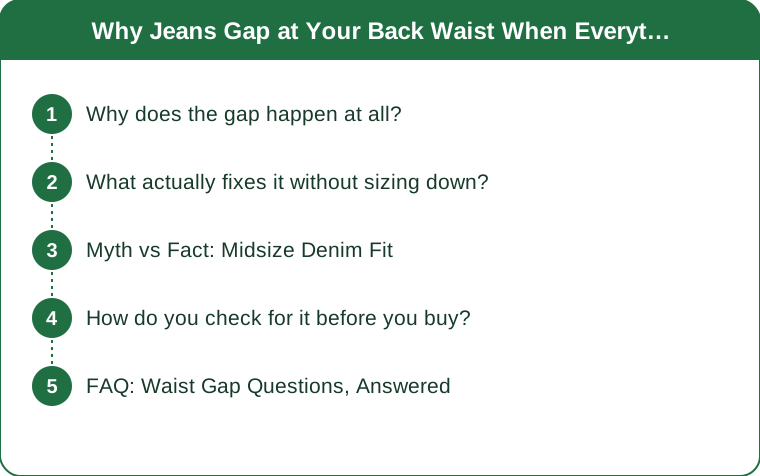
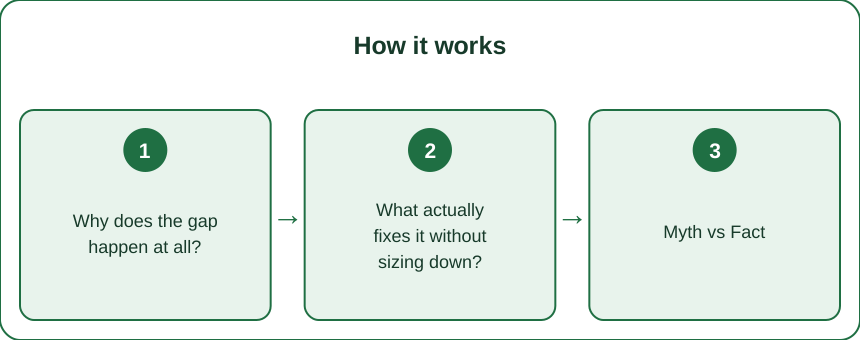
Why does the gap happen at all?
Grading works on ratios, and yours differs from the assumed one.
Patterns are graded from a fit model. A brand picks one body, then scales every size up and down using fixed proportional increments. Waist and hip grow together at a set ratio, usually around a 9 to 10 inch difference.
A larger hip-to-waist difference breaks the assumption. If your hips are 14 inches larger than your waist, jeans that fit your hips will have a waist roughly four inches too big. That excess has to go somewhere, and it goes to the back where your body curves away fastest.
The back is where it shows because of the lumbar curve. The waistband is a straight band; your lower back is not straight. The gap opens where the band bridges the inward curve above your hips.
Midsize bodies are especially affected because grading errors compound as sizes scale — the proportional increments that work in the middle sizes drift at both ends of the range.
And it gets worse when you sit. The waistband stays where it is while your pelvis rotates, which is why the gap you barely see standing becomes obvious in a chair.
What actually fixes it without sizing down?
Four approaches, in order of cost.
Look for a contoured or curved waistband. Some brands cut the waistband as a shaped piece rather than a straight strip, so it follows the lumbar curve. This is a construction detail, not a size, and it is the single biggest predictor of whether jeans will gap on you.
Go higher in the rise. A high rise sits at the natural waist where your circumference is smallest and the curve is gentler. A mid rise sits on the slope of the lumbar curve, which is the worst possible place for a straight band.
Get the waist taken in — this is a $15 to $25 alteration and it takes a tailor about twenty minutes. Removing two to three inches from the center back seam is routine work. If you buy jeans regularly, building this into the cost is more economical than continuing to search.
Choose fabric with recovery, not just stretch. A denim with 2% elastane and good recovery holds its shape; a soft stretch denim with poor recovery molds to your body for an hour and then bags out, creating a gap that was not there in the fitting room.
What does not work: a belt. It cinches the band but creates bunching at the front and does nothing about the gap when you sit.

Myth vs Fact: Midsize Denim Fit
Myth: A back gap means you should size down. Fact: Sizing down reduces the waist by roughly an inch while reducing the hip by the same inch. You will run out of hip room long before the waist gap closes, and you will get thigh strain lines as a bonus.
Myth: Stretch denim solves waist gap. Fact: Stretch lets you get into a smaller size but does nothing about the ratio. It often makes the gap worse over the day as the fabric relaxes at the waistband, which is the point of least tension.
Myth: Only curvy or hourglass bodies get waist gap. Fact: Anyone whose hip-to-waist difference exceeds the pattern’s assumption gets it, and that includes plenty of people who would not describe themselves as curvy. It is a ratio problem, not a shape label.
Myth: Expensive jeans do not gap. Fact: Price correlates with fabric quality and finishing, not with your specific ratio. Some very expensive brands grade for a straighter figure. The relevant variable is the waistband construction, and it is visible on a $60 pair as easily as a $300 one.
Myth: Tailoring ruins the jeans. Fact: Taking in the center back is completely standard and preserves the original topstitching on the sides. A competent tailor reuses the belt loop and the result is invisible. This is the fix people avoid longest and regret avoiding.
How do you check for it before you buy?
Two minutes in the fitting room saves most of the returns.
Sit down in them. Immediately, before you look at anything else. The gap that appears seated is the gap you will live with, and it is often twice what standing shows.
Feel the waistband shape. Run a hand along it — a contoured band curves and a straight band is flat. You can also check this on the hanger before trying them on.
Pinch the back waist. Anything over about 1.5 inches of excess pinched between your fingers means tailoring is required, not optional. Under an inch usually settles as the denim relaxes.
Check the rise against your navel. A rise that sits below your navel on a body with a strong hip-to-waist difference will almost always gap. At or above it will usually not.
Walk for a full minute. Rigid denim in particular reveals a different fit after it has moved and warmed slightly, which is a fair prediction of how it will behave in the fall when you are actually wearing them rather than trying them on.
FAQ: Waist Gap Questions, Answered
How much does it cost to take in a jean waist?
Typically $15 to $25 in most US cities for a center-back adjustment of one to three inches. If the jeans have a yoke or heavy topstitching the price can reach $35. Compared to buying another pair that also gaps, it is the cheaper path, and a good tailor can do several pairs at once.
Do high-waisted jeans always fit better on midsize bodies?
They fit the waist gap problem better, because the natural waist is a more consistent circumference and a gentler curve. Whether they fit you overall depends on your torso length — a high rise on a short torso can crowd the ribcage. The gap-specific benefit is real, but it is not a universal rule.
Why do the same jeans gap more after a few wears?
Denim relaxes most where tension is lowest and heat is highest — the waistband against your lower back qualifies for both. Fabrics with poor recovery stretch out and never come back without washing. If a pair gaps progressively through the week and resets after a wash, that is a recovery problem, and buying denim with a higher-quality elastane content is the actual solution.
TL;DR:
- Back waist gap is a hip-to-waist ratio mismatch with the pattern’s grading, not a sizing error.
- Sizing down runs out of hip room before it closes the waist — it makes things worse.
- Contoured waistbands and higher rises are the two construction features that predict a good fit.
- A $20 center-back alteration solves it permanently and is invisible when done well. Check the waistband shape on the hanger before you even try a pair on. That one habit filters out most of the jeans that were never going to work on your ratio.
Keep Reading
This article is for general informational and styling purposes only. Fit, sizing, and product availability may vary.
