Why Midsize Jeans Gap at the Back Waist and What Actually Closes It
Quick Answer: A back waistband gap happens when the difference between your waist and hip is larger than the pattern assumes, so a waistband sized to your hips is too big at your waist, and the curve of your lower back leaves a hollow the straight-cut band cannot follow. Midsize bodies hit this constantly because straight-size patterns are graded with a fixed waist-to-hip ratio that stops matching real proportions as sizes increase. The fixes, in order of value: buy a curve or contour fit, have the centre back seam taken in, or add elastic to the band. Sizing down never works.
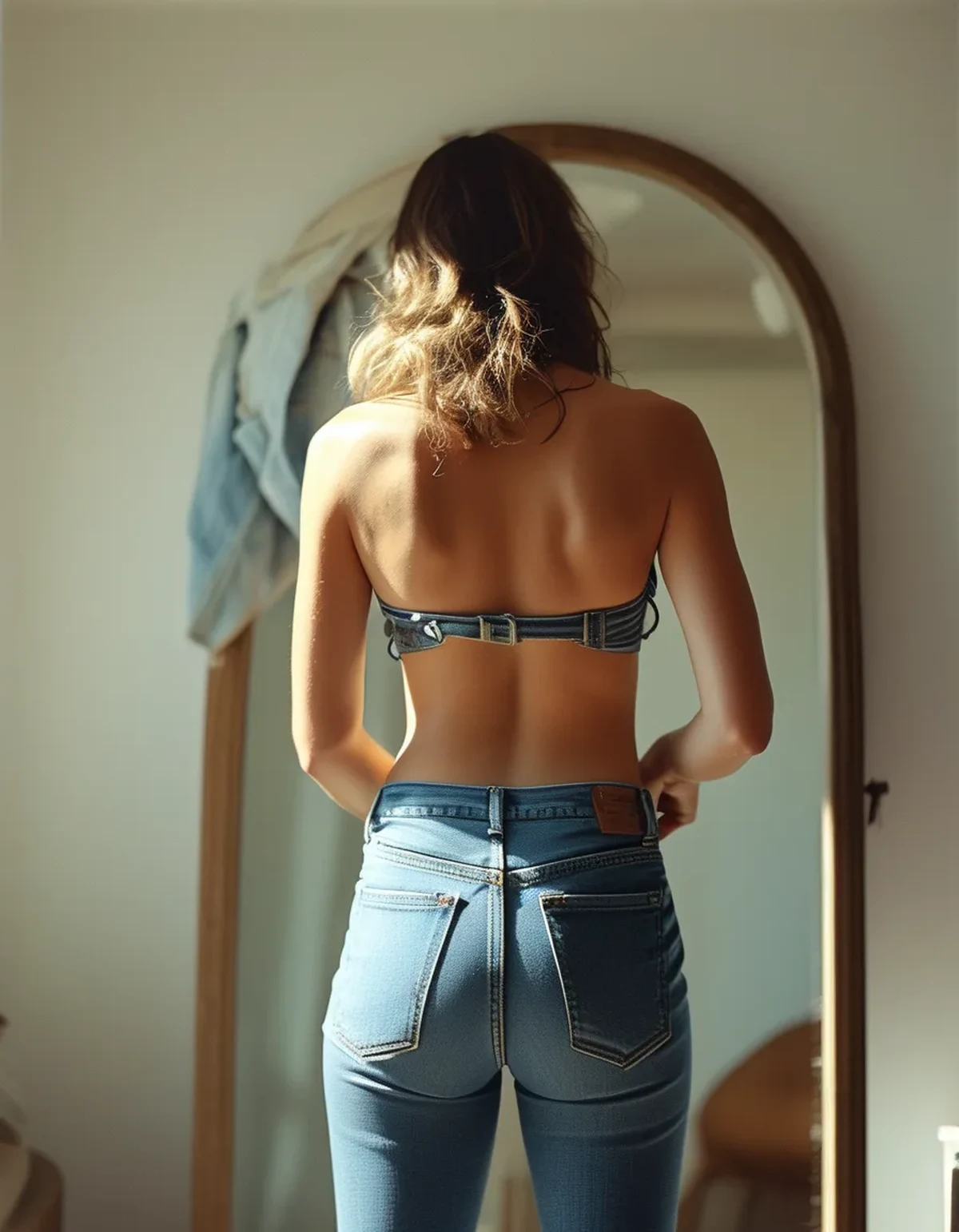
You pull them up, button them, and the front sits perfectly. Then you turn around and there is a gap at the back you could put a fist into.
This is not a sign that you bought the wrong size. Sizing down makes the front too tight and leaves most of the gap in place, which is a good clue that the problem is shape rather than size.

What causes the gap, specifically?
Two things at once, and separating them tells you which fix you need.
Cause 1: waist-to-hip ratio outside the pattern’s assumption. Most straight-size jeans are drafted around a fixed difference between waist and hip, commonly 25 to 28cm. If your difference is 33cm or more, a waistband sized to fit your hips is 5cm or more too large at your waist, and that surplus collects at the back where there is nothing to fill it.
Cause 2: lumbar curve. Even at a matching ratio, a pronounced lower-back curve creates a hollow between the top of the buttocks and the waist. A waistband cut as a straight strip cannot follow a concave curve, so it bridges across the hollow and stands away.
Why this hits midsize bodies particularly hard. Grading, the process of scaling a pattern across sizes, usually keeps the waist-to-hip relationship constant. Real bodies do not scale that way. Between roughly size 12 and 18, hip and thigh circumference commonly increase faster than waist circumference, so the mismatch grows precisely across the midsize range.
A quick diagnostic: measure your natural waist and your fullest hip, and subtract. Under 25cm of difference means you are close to the standard draft and the gap is probably a lumbar curve issue. Over 30cm means it is a ratio issue and a curve-fit cut will change your life more than any alteration.
Why does sizing down not fix it?
Because it addresses the wrong measurement.
What sizing down actually does: it reduces every measurement in the garment proportionally, including hip, thigh, and rise. Your waist gap closes a little, and your hips and thighs are now too tight, the rise is shorter so the waistband sits lower on a wider part of your torso, and the front strains.
The specific failure mode: the gap shrinks by perhaps 30 percent while the pockets pull open at the front, horizontal drag lines appear across the hip, and sitting down becomes an event. Most people wear the smaller size once and go back to the larger one.
Why the reverse also fails. Sizing up to accommodate the hips widens the waistband further, and the gap grows. Both directions make one thing worse.
What this tells you. When adjusting size in either direction makes something worse without solving the problem, you have a shape mismatch, not a size mismatch. That distinction is the single most useful thing to know about your own fit, because it redirects you from the size label to the cut.
A related tell: if you own one pair of jeans that fits and cannot explain why, look at its label for the words curve, contour, or a mention of a specific waist-to-hip drop. The brands that fit you are the ones drafting to your ratio.
What are the actual fixes, and what do they cost?
Four options, ranked by how well they work.
1. Buy a curve or contour fit. The real solution. These are drafted with a larger waist-to-hip differential, typically 33cm or more, and often with a contoured waistband that curves rather than sitting straight. Most major denim brands now offer one, sometimes labelled curve, curvy, contour, or listed with the drop measurement in the description. Cost: nothing extra, and you have to find the cut.
2. Take in the centre back seam. The standard alteration and the most effective one for an existing pair. A tailor opens the waistband at the centre back, takes in the seam in a wedge shape that removes most fabric at the top and tapers to nothing by the hip, and reattaches the band. Cost: typically the price of a couple of coffees to a modest amount depending on where you live. Removes up to about 5cm cleanly, and more than that starts to distort the back pockets.
3. Add elastic inside the waistband. A cheaper alteration where elastic is threaded through the back of the band. Cost: minimal, and often possible at home. Works, and the band gathers slightly when it contracts, which is visible under fitted tops.
4. A belt. Not a fix. It closes the gap at the top edge and creates fabric bunching below the band, and it does nothing when you sit. It is a workaround that most people use for years before discovering option 2.
On the alteration limit. If the gap needs more than about 5cm removed, a tailor may suggest taking it from the side seams as well, which preserves the back pocket placement. Ask about this specifically, because centre-back-only alterations on a large gap pull the pockets toward each other in a way that looks wrong.
A note on stretch denim. High-stretch denim gapes less initially and relaxes more through the day, so a pair that fits at 9am gaps by 3pm. Rigid and low-stretch denim holds its shape, which makes the gap more consistent and more fixable by alteration.
What Nobody Tells You About Waistband Gap
Contoured waistbands are the actual innovation, not the stretch. A waistband cut on a curve rather than as a straight strip can follow the concave shape of the lower back. Brands that do this well solve the problem at the source. It costs more to produce, which is why it appears on premium denim first.
The gap is worse in a mirror than in life, and worse in photos than in a mirror. This is not reassurance, it is a practical point: judge the fit sitting down, not standing. A waistband that gaps 3cm standing and digs when you sit is a different problem from one that gaps standing and sits comfortably.
Rise height changes the ratio you are fighting. A high rise sits at your natural waist, where the differential is largest. A mid rise sits lower, where the differential is smaller. Many people who cannot make high-rise jeans work find mid-rise fits without alteration, purely because the waistband is measuring a different part of the torso.
Yoke shape is the detail to look at. The V-shaped panel at the back of jeans, the yoke, exists specifically to shape the seat and lower back. A deeper, more angled yoke accommodates more curve. Flat, shallow yokes are cheaper to cut and gap more. You can see this on the hanger.
Two pairs from the same brand and size can behave differently. Fits within a brand are drafted separately, so the straight-leg and the wide-leg from the same label may have different waist-to-hip drops. The size that works in one is not information about the other.
Alterations are worth it on jeans specifically. People hesitate to alter denim because it feels like an expensive item to modify, and it is one of the highest-return alterations available. A pair you wear twice a week for two years costs very little per wear, and a gap that annoys you daily is worth the tailor’s fee.
Seasonal note: autumn is when this becomes visible again as you move from dresses and lighter trousers back into denim, and it is also when you layer, which changes the calculation. A back gap that disappears under a longer knit is genuinely less urgent than one that shows under a tucked-in shirt. Fix the pairs you wear with tucked tops first.
FAQ: Midsize Waistband Fit Questions, Answered
Why do my jeans gap at the back but fit everywhere else?
Your waist-to-hip difference is larger than the pattern assumes, so a waistband sized for your hips is too big at your waist. A curved lower back adds a hollow the straight band cannot follow.
Will sizing down fix a back waistband gap?
No. It shrinks every measurement, so the hips and thighs become too tight while most of the gap remains. A shape mismatch cannot be solved with a size change.
How much can a tailor take in at the back waist?
Up to about 5cm at the centre back seam without distorting the pockets. Beyond that, ask about taking some from the side seams as well to preserve the back pocket placement.
TL;DR:
- The gap is a waist-to-hip ratio mismatch plus a lumbar hollow, not a sizing error.
- Sizing down makes the hips and thighs worse and leaves most of the gap in place.
- Curve or contour fits solve it at the source. A centre back seam alteration solves it on jeans you already own.
- A belt is a workaround, not a fix, and it does nothing when you sit down.
Measure your waist and hip once and write the difference down. That single number tells you which cuts to filter for.
Keep Reading
This article is for general informational and styling purposes only. Fit, sizing, and product availability may vary.
