Why Midsize Bodies Often Need Tailoring More Than a Different Size
Quick Answer: Midsize bodies often fall between straight and plus size grading, where brands’ size jumps are largest — meaning no single size in a run fits proportionally right everywhere. Tailoring one or two specific points (waist, bust dart) often solves what changing sizes cannot.
You’ve sized up, sized down, and tried three different brands’ ‘midsize-friendly’ lines. Something is always slightly off — waist too loose, bust too tight, or the reverse. That’s not you being hard to fit; it’s a structural gap in how most size runs are graded.

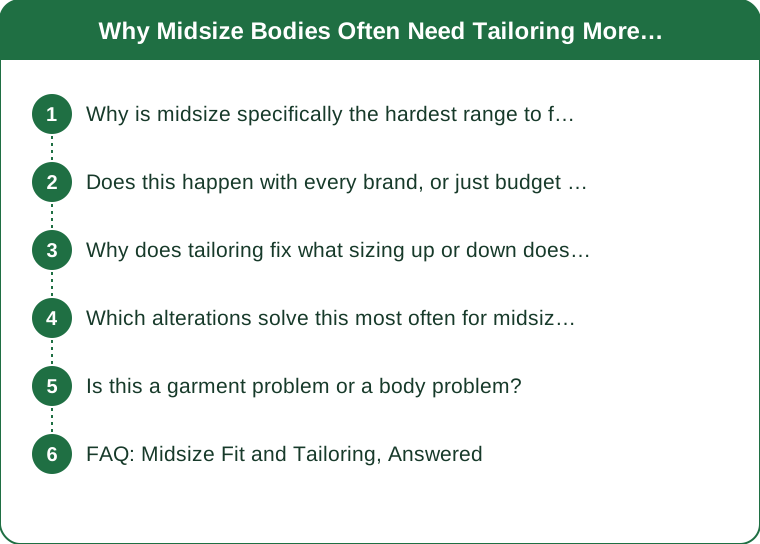
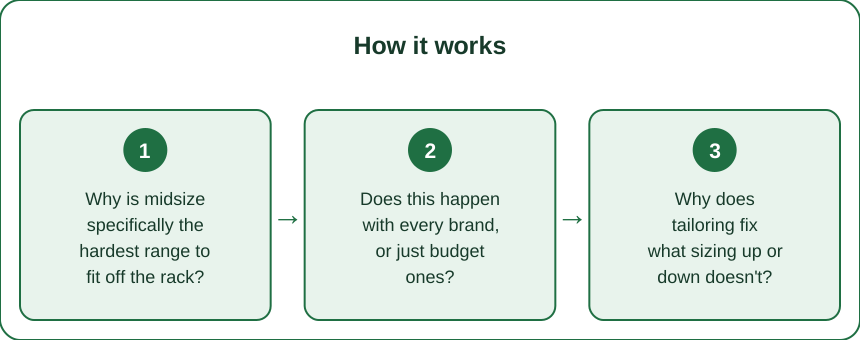
Why is midsize specifically the hardest range to fit off the rack?
Most brands grade sizes in fixed increments up to a certain point, then jump to a separate ‘plus’ size block with different proportions, rather than a continuous curve. Midsize bodies frequently sit right at or near that seam between the two blocks, where neither block’s proportions are built around that in-between range — explaining why one part of a garment fits while another doesn’t, across almost every size tried.
Does this happen with every brand, or just budget ones?
It happens across price points, though the size of the ‘jump’ at the straight-to-plus seam varies quite a bit by brand. Some brands have invested in a genuinely continuous size curve without a hard jump — these tend to fit midsize bodies more consistently — but this remains inconsistent across the industry rather than solved.
Why does tailoring fix what sizing up or down doesn’t?
Because the problem usually isn’t overall size, it’s proportion between two specific points (say, waist and hip, or bust and ribcage) that don’t scale together in most size grading. Sizing up fixes the tight point but makes the already-fitting point too loose; sizing down does the reverse. A tailor adjusting just the one problem point leaves everything else at its already-correct fit — which changing the overall size can’t do.
Which alterations solve this most often for midsize bodies?
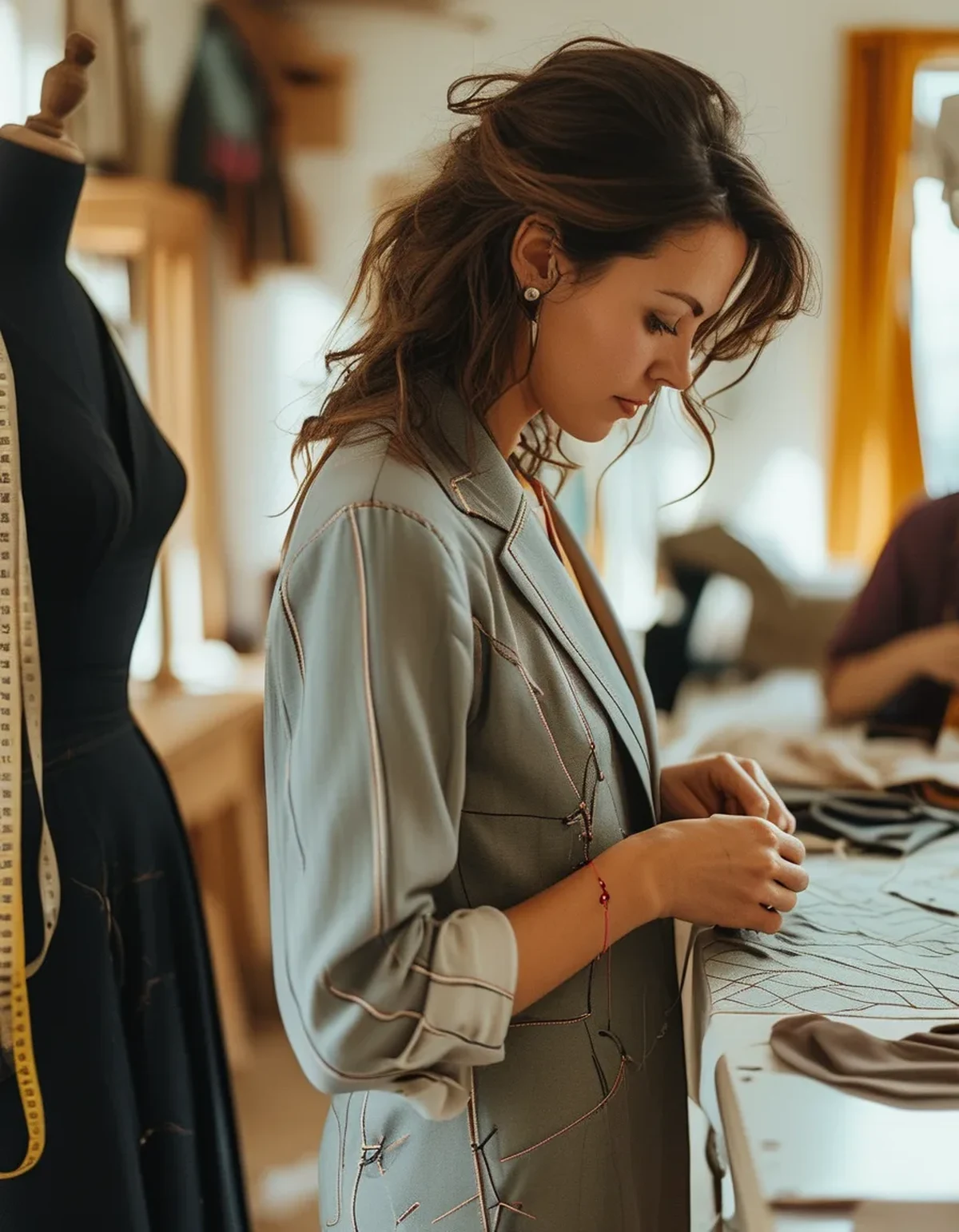
Waist take-ins on tops and dresses, and bust dart adjustments, are the two most commonly needed alterations reported by midsize-focused stylists and tailors. Both are relatively low-cost, straightforward alterations — far less expensive and disruptive than continuing to buy and return multiple sizes hoping one eventually works.
Is this a garment problem or a body problem?
It’s a garment grading problem, not a body problem — worth stating directly, since midsize sizing frustration is often internalized as a personal fit issue. The size curve itself has a structural gap at this range in much of the industry; tailoring is a practical workaround for that gap, not a sign anything about the body needs fixing.
FAQ: Midsize Fit and Tailoring, Answered
Is it worth paying for tailoring on lower-cost clothing?
Often yes for pieces you’ll wear regularly — a $15-20 waist take-in on a $40 top that otherwise doesn’t fit right can be worth it if it turns an unworn item into a regular-rotation piece.
How do you find your ‘problem point’ before buying, to know what to alter?
Try the same style in your usual size and compare where it’s tight versus loose in the mirror — tracking this across a few pieces usually reveals a consistent pattern point (like always tight at the bust, loose at the waist).
Are more brands starting to address the midsize gap directly?
A growing number are extending continuous grading through this range rather than a hard plus-size jump, though this remains an inconsistent, brand-by-brand situation rather than an industry standard yet.
TL;DR:
- Midsize bodies often sit at the seam between straight and plus size grading blocks
- That seam is where most brands’ size jumps are largest, causing proportional mismatch
- Tailoring one specific point (waist, bust) often solves what changing overall size can’t
- This is a garment grading gap, not a personal fit problem
Next time a piece almost fits, check if it’s a single-point problem — a tailor might solve in one visit what three more online orders wouldn’t.
Keep Reading
This article is for general informational and styling purposes only. Fit, sizing, and product availability may vary.