Why Midsize Bodies Often Need Different Bra Sizing Logic Than Standard Charts Assume
Quick Answer: Standard bra size charts assume a fairly fixed ratio between band size and cup volume, but midsize bodies frequently have proportions that fall outside that assumed ratio, which is why a size that matches the band measurement often has a cup that’s noticeably too small or too large — measuring both band and bust independently, rather than reading off a single chart row, and trying sister sizes (same cup volume, different band) usually solves this more reliably than standard charts do.
A midsize body following the standard band-to-cup ratio a chart assumes often lands on a size that’s technically “correct” by the numbers and still fits noticeably wrong in practice.

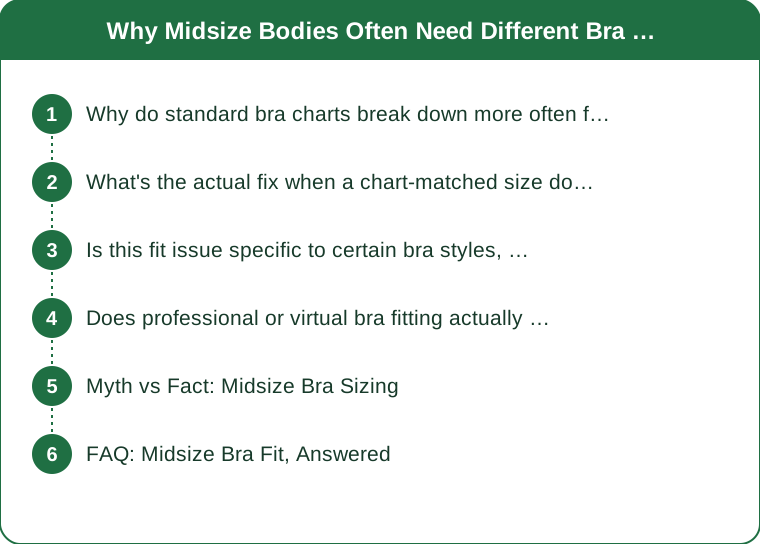
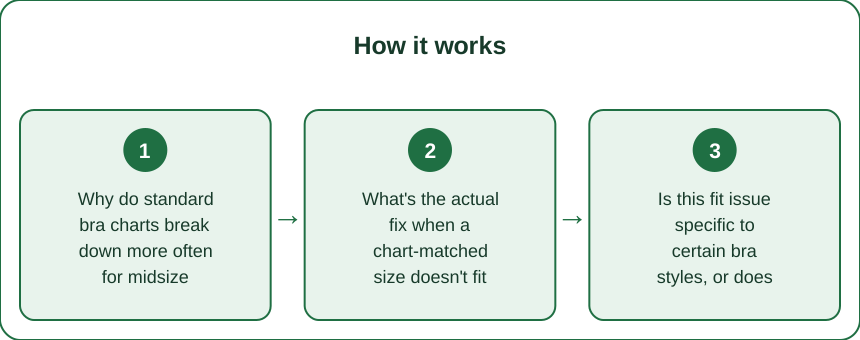
Why do standard bra charts break down more often for midsize bodies specifically?
Standard sizing charts are typically built around a single assumed ratio between band circumference and cup volume, but real body proportions vary far more than that single ratio accounts for — and midsize bodies, which sit between straight and plus-size charts, often fall into exactly the range where that assumed ratio stops matching reality. This is the same underlying sizing-gap problem that affects other garment categories for midsize bodies, applied specifically to bra fit.
What’s the actual fix when a chart-matched size doesn’t fit right?
Measuring band and bust independently, rather than relying on a single combined number from a chart, is the more reliable starting point — a band measurement that’s snug but not tight, paired with a bust measurement taken at the fullest point, gives two separate data points instead of one assumed ratio. From there, sister sizing (moving to a size with a smaller band and larger cup, or vice versa, that preserves the same actual cup volume) often solves a fit that the first chart-matched size got wrong.
Is this fit issue specific to certain bra styles, or does it show up across the board?
It shows up most noticeably in structured, molded-cup styles, which rely more heavily on the assumed band-to-cup ratio holding true, and less in soft, wireless, or bralette styles, which have more built-in stretch and forgiveness. For high-support activewear specifically, where fit accuracy matters most for actual function, the sister-sizing approach becomes especially worth the extra step.

Does professional or virtual bra fitting actually help more than self-measuring?
Often, yes — a professional or brand-specific virtual fitting, especially from a brand known for extended or half-size ranges, tends to catch the band-to-cup mismatch issue more reliably than a generic online size chart, since fitters are trained to look past the single “size” number to the actual shape and proportion in front of them. This is particularly worth seeking out for higher-support sports bras, where an imprecise fit has real functional consequences during a workout, not just a cosmetic one.
Myth vs Fact: Midsize Bra Sizing
Myth: If the band size matches, the cup size on the same chart row will fit correctly too. Fact: Band and cup don’t scale together at a fixed ratio for every body — measuring both independently catches mismatches a single chart row misses.
Myth: A bra that’s technically “too small” in the cup just needs to be worn in and it’ll stretch to fit. Fact: Cup fabric has some give, but a genuinely undersized cup causes spillage and strap issues that stretching alone won’t resolve — sizing correctly from the start avoids this.
FAQ: Midsize Bra Fit, Answered
What’s the fastest way to check if a bra’s cup size is actually correct, beyond just looking in a mirror?
Checking for smooth coverage with no spillage at the top or sides, and confirming the band sits level and doesn’t ride up in the back during movement, are both more reliable checks than appearance alone.
Does sister sizing really produce the same cup volume in a different size combination?
Yes — sister sizing works because cup letters represent different absolute volumes depending on the band size, so moving one band size down and one cup letter up (or the reverse) roughly preserves the same actual cup volume while changing the band fit.
Are there brands that specifically design for the midsize band-to-cup mismatch?
Some brands now offer extended size ranges with more granular band-and-cup combinations specifically to address this gap — searching for brands marketed around “true to size” or extended-range fitting tends to surface these options faster than general activewear searches.
TL;DR:
- Standard bra charts assume one fixed band-to-cup ratio that midsize bodies frequently fall outside of
- Measuring band and bust independently catches mismatches a single chart row misses
- Sister sizing (adjusting band and cup together) often fixes a fit the first chart-matched size got wrong
- Structured, molded-cup styles show this mismatch more than soft or wireless styles
A midsize body’s “wrong” bra fit usually isn’t a sizing failure on the wearer’s part — it’s a chart built around one ratio that doesn’t hold for every real body, and independent measuring plus sister sizing works around it.
Keep Reading
This article is for general informational and styling purposes only. Fit, sizing, and product availability may vary.
