Why Jeans Gap at the Waist on Midsize Bodies and What Actually Fixes It
Quick Answer: Jeans gap at the back waist because standard blocks are drafted with about a 10-inch difference between waist and hip, and many midsize bodies carry a 12-to-14-inch difference. When you size for your hips, the waist comes along oversized. The real fixes, in order of reliability: buy curvy-cut lines drafted with a bigger waist-hip ratio, get the waist taken in for $20 to $35 — the single most worthwhile alteration in denim — or use stretch-heavy high-rise cuts that contract over the smaller measurement. Belts manage the gap; they do not fix it.
The fitting-room math never favors you: the pair that closes over your hips gaps at the waist, the pair that fits the waist will not go over your thighs. Neither pair is wrong about your body. Both were drafted for a ratio you do not have, and the sooner it gets treated as a pattern problem instead of a body problem, the cheaper and calmer denim shopping gets.

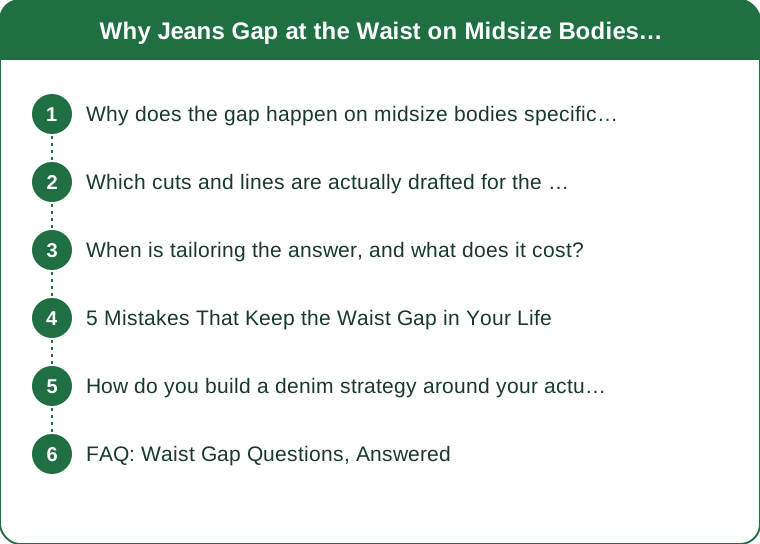
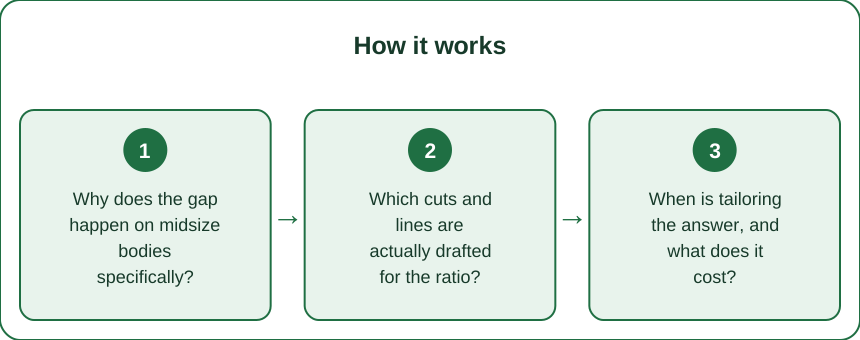
Why does the gap happen on midsize bodies specifically?
Because sizing up moves every measurement, and you only needed one of them to move.
A standard straight-size block assumes roughly a 10-inch spread between waist and hip. Grade that pattern up for a size 12 or 14 body and the assumption travels with it. But midsize bodies are exactly the range where real-world ratios diverge hardest from the block — hourglass and pear proportions commonly run 12 to 14 inches of difference, and denim, being rigid or nearly so, cannot absorb the mismatch the way a knit can.
So you size to the widest point, because fabric must physically close over hips and thighs, and you inherit a waistband cut for someone two sizes bigger through the middle. The gap is the leftover of a ratio decision made at the drafting table.
Rise placement compounds it. Mid-rises land at the narrowing taper of the waist, where a too-big band has nothing to grip, so it stands away and slides. Very low rises sit below the taper entirely — which is why the gap felt smaller in eras of low-rise denim and roared back with high waists.
And rigid 100 percent cotton denim shows the flaw most honestly, which is why vintage-style jeans produce the most dramatic gaps of all.
Which cuts and lines are actually drafted for the ratio?
The industry’s partial answer is the curvy fit, and it is worth taking literally.
A true curvy line is not a bigger size or a euphemism — it is a different block, drafted with roughly two to three extra inches of waist suppression relative to hip. Several mainstream denim brands now run one, and the difference on a 13-inch-ratio body is immediate: the band sits against the back instead of near it.
Beyond the label, look for these construction cues on any pair:
Higher back rise than front. A back rise cut taller lets the band climb over the seat and land at the narrow waist instead of bridging across it.
Contoured or curved waistband. A band cut as an arc hugs a tapering waist; a straight-cut band stands away by geometry alone.
Darts or seaming near the back yoke. A deeper V-shaped yoke, or visible back darts, is suppression you can see.
Stretch with real recovery. Two to four percent elastane with a firm hand contracts over the smaller measurement. This is the same principle that makes high-waisted yoga pants fit a 13-inch ratio effortlessly — the fabric does the suppressing — and it is why a stretch skinny gaps less than a rigid straight at identical measurements.
Gap of an inch or less: stretch and cut choices can absorb it. More than that, keep reading.
When is tailoring the answer, and what does it cost?
Whenever the gap exceeds about an inch — and far more often than people use it.
Taking in a denim waist is a standard, routine alteration: the tailor opens the center-back seam through the waistband and yoke, removes the excess, and rebuilds it. Expect $20 to $35, a week’s turnaround, and a result no cut off any rack will match, because it was fitted to your exact ratio.
The honest math: a $70 pair plus a $30 alteration is a $100 pair that fits — against a lifetime of $70 pairs that never quite did, worn twice each. Cost per wear settles the argument fast.
What to know before the counter:
Buy for hips and thighs, always. Waists can come in two-plus inches; thighs cannot be let out meaningfully. The alterable direction only runs one way.
Belt loops survive. A competent alteration re-sets the center-back loop; ask, and check at pickup.
Heavy stretch complicates it slightly. Elastane-rich denim needs a tailor who sews knits confidently — worth one question when you drop off.
Wash before altering. Denim with any cotton content shifts a little in the first wash; alter the settled version, not the store version.
The only pairs not worth the fee are the ones already failing elsewhere — seat too tight, rise wrong, fabric thin. Tailoring perfects an almost-right pair; it cannot rescue a wrong one.

5 Mistakes That Keep the Waist Gap in Your Life
1. Sizing down and rationing breath. Closing the gap by squeezing the hips into a smaller size trades a fit problem for a comfort problem — whiskering across the front, a waistband trench, and jeans you unbutton in the car. The hips were right the first time.
2. Expecting the belt to be the fix. A belt cinches the excess into gathers and holds the band roughly in place; under any top that skims the waist, the bunching prints through. Belts are management. On a gap over an inch, they are visibly losing the argument by mid-afternoon.
3. Judging the pair standing still. Waist gaps reveal themselves in motion — sit, squat to reach a low shelf, and check the mirror behind you. The pair that gaps only when seated still gaps forty times a day.
4. Treating the elastic-back waistband as a kids’ feature. Several brands hide elastic inside the back band of adult jeans now, and on a high-ratio body it is quietly the most comfortable rigid-denim workaround on the market. Pride is a bad reason to skip it.
5. Reading the gap as a flaw in you. Fifty fitting rooms teach the wrong lesson. The block has one ratio; bodies have dozens. The pairs that fit exist — they are just labeled curvy, cut high in the back rise, or waiting a week at the tailor.
How do you build a denim strategy around your actual ratio?
Measure once, then shop like you know.
Take two numbers: natural waist at the narrowest point, and hip at the fullest — including where your seat actually is fullest, not where the chart guesses. Subtract. That difference is your denim identity, more useful than any size number, and it sorts every future pair in seconds: under 10 inches, standard blocks serve you fine; 11 to 12, prioritize stretch, contoured bands, and higher back rises; 13-plus, start at curvy lines and befriend a tailor.
Then let the ratio pick your battles by fabric. Rigid vintage-style denim is the gap’s natural habitat — buy it expecting the $30 alteration as part of the price. Mid-stretch is the everyday compromise. And for the days denim is not worth any negotiation, the athleisure lane exists precisely because knit waistbands never gap: a dark straight-leg pair of buttery-soft leggings or a structured flare reads polished for errands and travel while fitting both measurements at once — a useful pressure valve, not a surrender.
Keep a note on your phone: brand, line, size, and what the waist did. Three entries in, patterns emerge; five entries in, you can order online with real odds.
And re-measure yearly. Ratios drift with bodies, and the note that saves you is the current one.
FAQ: Waist Gap Questions, Answered
Can I shrink the waist with hot water or a dryer instead of a tailor?
On high-cotton denim, heat shrinks everything somewhat — including the hips and inseam you liked — and the waist relaxes back within a few wears. It is a temporary whole-pair effect, not a targeted fix. The tailor removes fabric only where the excess lives.
Do the TikTok tricks — button-loop folds, bra-hook hacks — actually work?
As same-day management under a loose top, yes, they hold the band closed. They all gather the excess rather than removing it, so anything fitted shows the bunch. Fine for one evening; not an answer for a pair you wear weekly.
Is the gap worse with high-rise jeans?
Usually, because a high rise finishes at your narrowest point, where the mismatch between band and body peaks. But a high rise with real waist suppression — curvy cut, contoured band — gaps least of all, because it is anchored at the narrow point by design. The rise is not the villain; the straight-cut band at that rise is.
My gap is in front, not back — same problem?
Usually a different one: a front gap most often signals a rise shape mismatch or a band standing away from a softer belly rather than a waist-hip ratio issue. Curved front bands, higher stretch, and mid rises tend to serve that fit better — and the take-in alteration works at side seams too.
TL;DR:
- The gap is drafted in: standard blocks assume a 10-inch waist-hip difference, and many midsize bodies run 12 to 14.
- Shop curvy-cut lines, contoured waistbands, higher back rises, and real stretch first — they are drafted closer to your ratio.
- Over an inch of gap, the $20-to-$35 waist alteration is the definitive fix; buy for hips, tailor the waist, wash before altering.
- Belts and viral hacks manage a gap for a day; measuring your own ratio and keeping a fit note ends the guessing for good.
Subtract your two numbers this week and write the result down. Every fitting room after that stops being a verdict on your body and becomes a quick check of whether the pattern in your hands respects your math.
See It in Motion
Seen here: High Waist Embossed Yoga Leggings with Side Pockets — shop it on bubblelime.com
Keep Reading
This article is for general informational and styling purposes only. Fit, sizing, and product availability may vary.
