Why a Coat Is the Hardest Thing a Midsize Body Buys All Year
Quick Answer: Coats are hardest for midsize bodies because outerwear is drafted with less grading precision and more layering ease than any other category, and the failure points — shoulder width, upper arm circumference and bust closure — cannot be fixed by sizing up. A coat that closes over the bust usually has shoulders 3 to 5 cm too wide. The strategy is fit the shoulder and upper arm first, accept an open front or choose a wrap style, and budget for tailoring the waist and sleeve.
The top fits. The jeans, after some work, fit.
Then you try a coat and it either strains across the bust or hangs off your shoulders like it belongs to someone else.
There is a structural reason this specific item is worse than everything else.

Why is outerwear harder than every other category?
Because it combines the worst version of several problems midsize bodies already deal with.
Grading is cruder. Outerwear is often produced in fewer sizes with larger jumps between them, because it is expensive to manufacture. A range that runs 8 to 18 in four sizes has to make each size cover more ground, and midsize bodies live exactly in the gaps.
Layering ease is added uniformly. Coats are drafted with extra room to fit over clothing, and that ease is added roughly proportionally across the garment. Bodies do not gain volume proportionally, so the ease lands generously in some places and not at all in others.
Upper arm circumference is rarely graded properly. It is one of the least well-handled measurements in the industry. Many midsize wearers can close a coat and still not be able to bend their elbow comfortably.
Shoulder seams cannot be moved cheaply. On a lined, structured coat, altering the shoulder means dismantling the sleeve head, the lining and often the collar. This is why the shoulder must fit off the rack.
Bust closure is the visible failure. A coat that pulls into a horizontal wrinkle at the bust is the classic midsize outerwear photograph, and it is caused by insufficient bust circumference relative to shoulder width — a grading assumption, not a body problem.
And the price makes experimentation expensive. You will happily try five tops. Nobody wants to order five coats, so people settle faster on outerwear than on anything else they own.
Which measurement should decide the size?
Shoulder first, upper arm second, bust third. In that order, and it is not the order most people use.
Shoulder point to shoulder point across the back. If the shoulder seam sits past the edge of your shoulder by more than about 1.5 cm, the coat will read oversized and droop no matter how well the rest fits. This is the measurement that cannot be altered affordably.
Upper arm circumference plus 8 to 10 cm of ease. Measure the fullest part of your upper arm and check the garment’s flat bicep measurement doubled. Coats need real ease here because sleeves must accommodate a jumper.
Full bust, then decide whether you need it to close. This is the one you can negotiate. A great many good-looking coats are worn open.
Waist and hip are almost always adjustable. Taking in a coat at the side seams and back is standard, relatively affordable tailoring. Do not let a loose waist decide your size.
Back width matters if you carry a bag or drive. Measure across the back at armpit level. Coats that fit standing still and bind when you reach forward have failed here.
Note your preferred hem point too. Mid-thigh and knee-length both work on midsize frames; the awkward length is the one landing at the widest part of the hip, which broadens the silhouette.
What coat styles actually work?
Structural choices that sidestep the closure problem entirely, rather than fighting it.
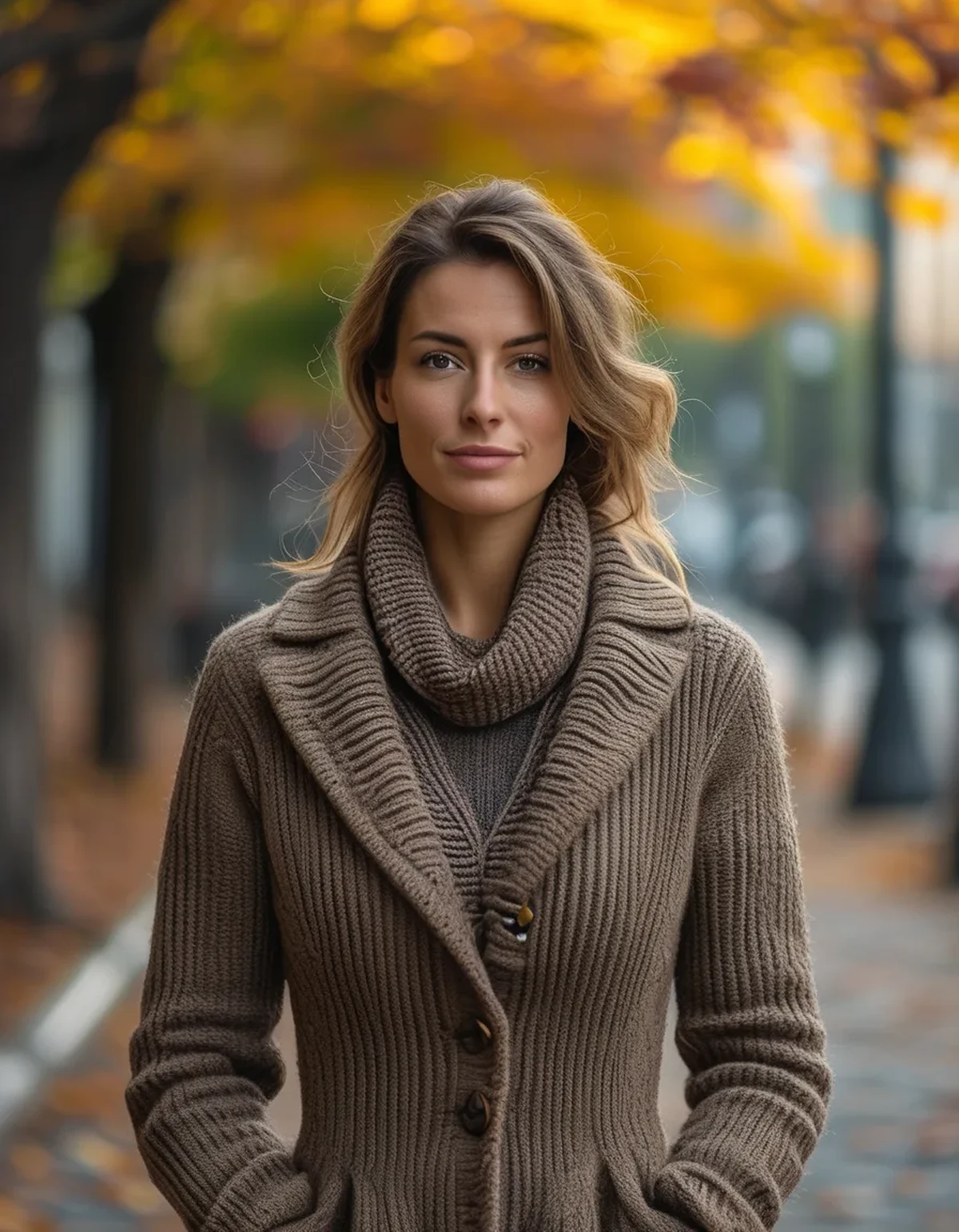
Wrap and belted coats solve bust closure by design. No buttons means no strain point, and the belt lets you define the waist independently of the bust measurement. This is the highest-success category by a distance.
Single-breasted with a slightly lower button stance flatters more than double-breasted. Double-breasted adds visual width across exactly the area that is already the constraint.
Raglan and drop-shoulder sleeves are more forgiving. There is no set shoulder seam to sit in the wrong place, which removes the single hardest fit point. This is why raglan wool coats and shackets work so well.
Look for princess seams or back darts. They mean the pattern is shaped rather than boxy, which gives a tailor something to work with and usually fits better as bought.
Choose a coat with a real vent or generous hem sweep. A narrow hem on a fuller hip pulls open and looks strained walking. Sweep is a spec worth checking.
Consider outerwear from brands with extended sizing rather than plus-only ranges. A brand that runs 6 to 22 in one continuous grade usually handles the midsize range better than one that grades 6 to 14 and then restarts at 16.
Budget 10 to 15 percent of the coat price for tailoring. Taking in the waist, shortening a sleeve and moving a button are all routine. A tailored mid-price coat beats an untailored expensive one every time.
Seasonal note: the useful midsize outerwear sizes sell through first because they are the densest part of the market. Shopping in early September rather than late October roughly doubles the available options, and last season’s stock is discounted right now.
5 Mistakes Midsize Shoppers Make With Coats
Sizing up until the bust closes. This is the most common one and it produces a coat with drooping shoulders, a dropped armhole and sleeves that swamp the hand. Fit the shoulder and wear it open.
Trying coats on over a t-shirt. You will wear it over a jumper in November. Try it on over the thickest layer you actually plan to wear, or you will discover the sleeve problem in December.
Ignoring the sleeve until it is too late. A coat you cannot bend your arm in will not get worn, regardless of how good it looks standing still. Reach forward and cross your arms in the fitting room.
Assuming tailoring is unaffordable. Taking in a waist and shortening sleeves is common, routine work. People routinely spend hundreds more looking for an off-the-rack miracle.
Buying a belted coat and never using the belt. A belted coat worn open and loose gives up the entire advantage of the style. If you do not want to belt it, buy a different shape.
The bonus mistake: shopping for outerwear in the same size you wear in that brand’s knitwear. Outerwear grading is different, often by a full size, and the number on the label carries no information across categories.
FAQ: Midsize Coat Questions, Answered
Should a coat close over my bust?
Only if you want it to. Many well-fitting coats are worn open, and choosing a size that closes usually costs you the shoulder fit.
How much does coat tailoring cost?
Taking in the waist and shortening sleeves is typically a modest fraction of the coat’s price. Moving shoulders is the expensive one — avoid needing it.
Are wrap coats really better for midsize bodies?
Structurally, yes. They remove the closure constraint and let you set the waist independently, which is the core of the problem.
What length is most flattering?
Either above mid-thigh or at or below the knee. Avoid hems landing at the widest point of the hip.
Can I have the bust let out?
Sometimes, if there is seam allowance and the coat is not heavily structured. Ask before buying rather than after.
Should I buy from plus ranges or straight ranges?
Whichever brand grades continuously through your size rather than restarting the block. Continuous grading is the signal worth looking for.
TL;DR:
- Coats are hardest because grading is cruder, ease is uniform and shoulders cannot be altered cheaply.
- Fit in this order: shoulder, upper arm, then bust — and the bust is the negotiable one.
- Wrap, belted and raglan styles remove the closure problem structurally.
- Try it on over your actual winter jumper, and reach forward before deciding.
- Budget 10 to 15 percent for tailoring; a tailored mid-price coat beats an untailored expensive one.
Shop in September. The midsize range is the first thing to disappear.
Keep Reading
This article is for general informational and styling purposes only. Fit, sizing, and product availability may vary.
