The Armhole Is Why Midsize Tops Feel Wrong Even in the Right Size
Quick Answer: Grading systems scale chest and length generously but scale armhole depth conservatively, often by only a quarter inch per size. So as you go up sizes, the armhole gets relatively tighter. That is why a top can fit at the bust and still bind when you lift your arms.
You size up and the top gets baggier everywhere except the one place that was actually the problem. Then you size back down and it fits the body but pins the arm. Neither size is wrong. The grading is.

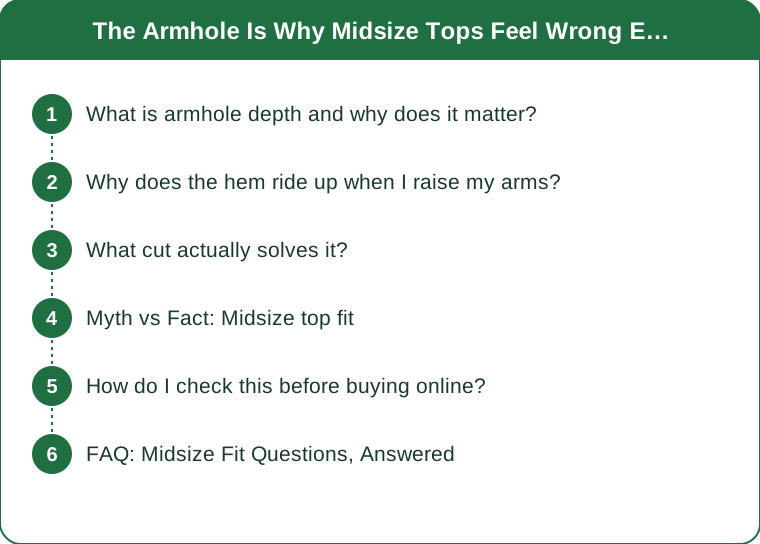
What is armhole depth and why does it matter?
Armhole depth is the vertical distance from the shoulder seam down to the bottom of the armhole. It determines how far you can lift your arm before the whole garment starts traveling with it.
On a well-graded top, that depth grows with size, because larger frames need more clearance. In practice, many brands grade it at 0.25 inches per size while grading the chest at 2 inches per size.
The result is a mathematical squeeze. Four sizes up gives you 8 inches more chest and 1 inch more armhole. The armhole is now proportionally the tightest part of the garment, and it will be the thing you feel.
Why does the hem ride up when I raise my arms?
Because a shallow armhole has nowhere to give, so the fabric borrows length from below. Lift your arms and the side seam pulls the hem upward.
This is why the same top can feel fine at the desk and betray you in an overhead press or reaching for a top shelf. It is not the length of the top. It is the armhole passing stress down to the hem.
Test it before you buy: raise both arms fully overhead in the fitting room. If the hem climbs more than an inch, the armhole is too shallow, and no size change on the rack will fix it.
What cut actually solves it?
Look for these, in rough order of effectiveness:
- Raglan sleeves. The diagonal seam runs from underarm to neckline and eliminates the fixed armhole corner entirely
- Dropped shoulder. Moves the seam down the arm, which effectively deepens the opening
- Set-in with a gusset. Rare in activewear but excellent, since a diamond panel at the underarm adds range without adding bulk
- Racerback and cutaway. Removes the binding point from the equation, though it changes the bra requirement
Avoid tight set-in sleeves with a narrow, high-cut armhole. That construction is graded for a narrow frame and it does not translate up.

Myth vs Fact: Midsize top fit
Myth: Sizing up fixes tightness. Fact: it fixes circumference, not armhole geometry, and it introduces new problems at the shoulder and neckline.
Myth: Stretchy fabric solves everything. Fact: stretch handles circumference, not depth. A four-way-stretch fabric with a shallow armhole still pulls the hem up, because the geometry is short before the fabric is tight.
Myth: Petite or tall sizing changes the armhole. Fact: petite typically shortens the torso and sometimes the armhole too, which makes it worse. Tall lengthens the body but often leaves the armhole alone.
Myth: Expensive brands grade better. Fact: price correlates with fabric quality far more than with grading philosophy. Some mid-price brands with dedicated midsize lines grade armholes properly and many luxury lines do not.
How do I check this before buying online?
Measure a top you own that moves well. Lay it flat, measure straight down from the shoulder seam to the bottom of the armhole curve, and write the number down.
For most midsize frames the comfortable range lands between 8.5 and 10 inches measured flat. Below 8 inches, expect binding.
Then look for that number in the listing, ask customer service, or check reviews for the phrase “tight under the arms.” Reviews are unreliable about sizing in general but remarkably reliable about armholes, because it is a sensation people describe consistently. One saved measurement turns online shopping from a gamble into a filter.
FAQ: Midsize Fit Questions, Answered
Can a tailor fix a tight armhole?
Sometimes. A tailor can lower the armhole slightly and reset the sleeve, but only if there is seam allowance. On knit activewear there usually is not.
Is this the same as needing a bigger bust size?
No, and confusing the two is common. Bust fit is circumference at the fullest point; armhole is vertical clearance. You can have plenty of one and none of the other.
Why do men’s tops sometimes feel better?
Men’s grading generally uses deeper armholes as standard. Borrowing a men’s tee is a legitimate diagnostic, and if it feels dramatically better, armhole depth was the problem.
TL;DR:
- Chest grades about 2 inches per size while armhole depth often grades only 0.25 inches
- The hem riding up when you lift your arms is the tell for a shallow armhole
- Raglan and dropped-shoulder cuts fix it; sizing up does not
- Measure 8.5-10 inches from shoulder seam to armhole bottom on a top that works
Go measure the armhole on the one top you always reach for. That number is the most useful thing in your closet, and it explains a rack of tops that fit on paper and fought you in practice.
Keep Reading
This article is for general informational and styling purposes only. Fit, sizing, and product availability may vary.
