How to Shop When You Are Between Standard and Plus Sizing
Quick Answer: The gap exists because standard and plus ranges are drafted from different fit models with different proportions, not merely different measurements. The plus range is usually graded with more bust, more hip, and a longer rise relative to the waist. The workarounds that actually help: shop brands with continuous sizing, prioritise the largest measurement and alter down, and favour garments with built-in adjustability - wrap, tie, elastic-back, and knit constructions. Budget for alterations as part of the purchase price rather than as a failure.
Knowing why the gap exists makes it much easier to navigate than treating each disappointment as a personal fit mystery.
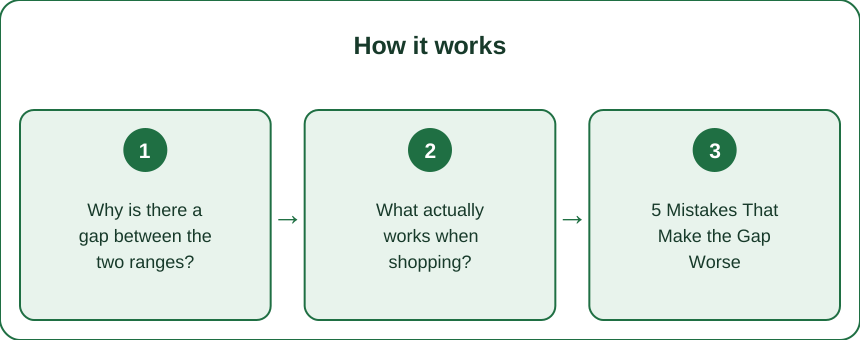
Why is there a gap between the two ranges?
Because they are two separate drafting systems that happen to share a number line.
Standard ranges are graded from a fit model at around a size 8, scaled up. Plus ranges are graded from a different fit model, often around a size 18 or 20, scaled both ways. The two systems meet awkwardly around 14 to 18, which is exactly where the gap sits.
Grading is not simply scaling. As sizes increase, brands make assumptions about where the extra volume goes - more at the bust, more at the hip, a longer rise. Those assumptions were made about a body that may not be yours.
Plus ranges usually assume a longer rise and a fuller upper arm. If your proportions do not match, the smallest plus size can be simultaneously loose at the waist and correct at the hip.
Standard ranges at the top end often stop grading properly. The largest one or two sizes are frequently scaled without re-drafting, so armholes get tight, rises get short, and shoulders sit wrong even though the bust and waist numbers look right.
And ranges are not consistent between brands. A size 16 in one brand corresponds to a size 12 in another. This is not vanity sizing alone - it is genuinely different fit models, which is why shopping by measurement rather than by size label is the single highest-leverage change available.
What actually works when shopping?
Six strategies, roughly in order of effectiveness.
1. Shop brands with continuous sizing. Brands that grade a single range from small through to large, using one fit model progression, do not have this gap at all. They are the cleanest solution and they are becoming more common.
2. Buy for the largest measurement and alter down. Taking a waist in is straightforward and inexpensive. Letting a hip or bust out is often impossible because there is no fabric in the seam allowance. This one principle prevents most bad purchases.
3. Favour built-in adjustability. Wrap dresses, tie waists, elasticated backs, drawstrings, and knit fabrics all accommodate a range of proportions by design. They are not a compromise - they are a different engineering approach.
4. Separate your top and bottom sizes entirely. Buying separates in two different sizes is normal and correct. Dresses and jumpsuits are the hard category precisely because they force one number to cover both.
5. Measure and keep the numbers. Bust, underbust, waist at the narrowest point, hip at the fullest, and inseam - in centimetres, written down in your phone. Then read the size chart rather than the size label. This works because size charts are usually honest even when size labels are not.
6. Budget for alterations. A tailor taking in a waist typically costs a fraction of the garment. A well-altered piece from the plus range beats a straining piece from the standard range in both comfort and appearance, and it lasts longer because it is not under constant stress.
5 Mistakes That Make the Gap Worse
1. Sizing down because the number feels better. A garment under tension pulls at every seam, creates horizontal stress lines, and wears out at the stress points. The number is invisible; the strain is not.
2. Buying the largest standard size on principle. The top one or two sizes in a standard range are often poorly graded - scaled rather than re-drafted - which means armholes, shoulders, and rises are wrong even when the bust and waist measurements match.
3. Assuming plus means bigger everywhere. Plus ranges are drafted with different proportions, not just larger numbers. The smallest plus size may be too long in the rise and too full in the arm while fitting the hip correctly.
4. Shopping without measurements. Trying things on hopefully, brand after brand, is exhausting and it produces no information. Five minutes with a tape measure converts shopping from a mood into a lookup.
5. Treating a poor fit as a body problem. The gap is a manufacturing artefact of two grading systems meeting badly. A garment that does not fit is information about the garment, and internalising it as anything else makes shopping worse and slower.
How does this change for autumn buying?
Cool-weather clothing has more structure, which makes fit both more important and more fixable.
Outerwear is the hardest category and the most worth getting right. Coats must fit over layers, and shoulder fit is the one thing a tailor cannot easily change. Buy for the shoulders and alter the body - the reverse never works.
Knitwear is the most forgiving thing in the shop. A good knit accommodates a wide range of proportions and drapes rather than strains. This is the category where the gap is least of a problem, so it is worth investing here.
Structured trousers are where alterations pay best. A waistband taken in by 5cm is a routine, cheap alteration, and it converts an otherwise correct trouser into a well-fitting one. Buy for the hip and thigh, always.
Watch rise length in autumn trousers. Heavier fabrics disguise a short rise less well than jersey does, and a rise that is too short reads immediately as ill-fitting.
And this is the best season for buying well. Autumn ranges arrive with more structured pieces, better fabrics, and longer wear windows - the pieces most worth altering, and most worth keeping for several years. A coat and a pair of trousers, both properly fitted, carry more of a winter wardrobe than anything else you can buy.
FAQ: Midsize Shopping Questions, Answered
Why does the same size fit differently in every shop?
Because each brand grades from its own fit model, and those models differ in proportion as well as measurement. Size labels are not standardised; size charts generally are honest, so shop against the chart.
Should I buy standard or plus when I am between?
Whichever fits your largest measurement without strain, then alter down. Taking in is easy and cheap; letting out is usually impossible for lack of seam allowance.
Which garment types are most forgiving?
Wrap styles, tie waists, elasticated backs, and knits. All accommodate proportional variation by design rather than by luck.
Are alterations worth the cost?
Usually yes. Taking in a waist typically costs a fraction of the garment, and an altered piece fits better, looks better, and lasts longer because it is not under constant tension.
What measurements should I keep?
Bust, underbust, waist at the narrowest point, hip at the fullest, and inseam - in centimetres, saved in your phone. That set covers almost every size chart you will encounter.
What is continuous sizing and why does it help?
A single range graded from the smallest to the largest size using one fit model progression, rather than two separate ranges. It eliminates the drafting discontinuity that creates the gap entirely.
TL;DR:
- The gap is a drafting artefact - standard and plus ranges use different fit models, so they meet badly around 14 to 18.
- Buy for your largest measurement and alter down; taking in is cheap, letting out is usually impossible.
- Favour continuous-sizing brands and garments with built-in adjustability: wrap, tie, elastic-back, knit.
- Keep your measurements in your phone and shop the size chart, not the size label.
- For autumn, buy coats for the shoulders and trousers for the hip, then have the waist taken in.
The most practical thing to carry away is that a garment that does not fit is telling you about the garment’s fit model, not about you - and that reframe turns shopping from a verdict into a lookup problem.
Keep Reading
This article is for general informational and styling purposes only. Fit, sizing, and product availability may vary.